“Veneer” is one of those words everyone’s heard, but ask most people what actually happens to a tooth during the process, and the answer gets vague fast. Here’s the plain version.
The Basic Idea
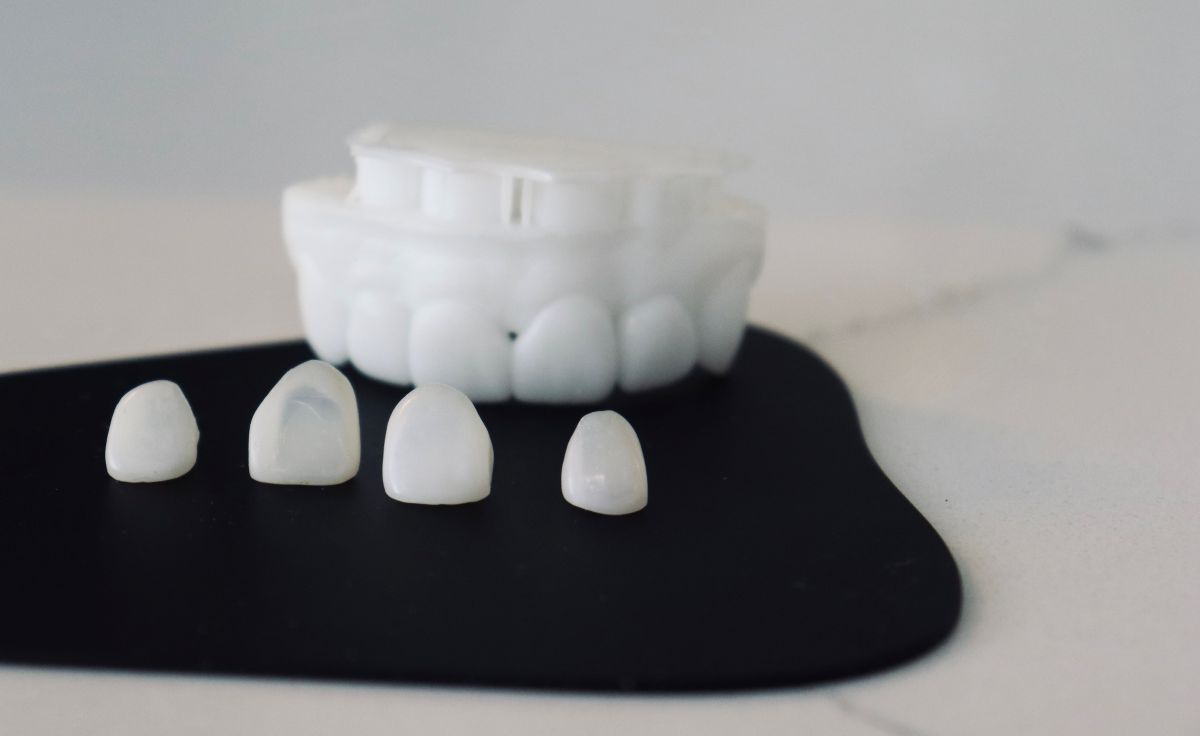
A veneer is a thin shell placed over the front surface of a tooth to change its shape, color, or size. It doesn’t replace the tooth — it covers the visible surface, the way a new façade changes the look of a building without touching the structure behind it.
Veneers are almost always used on front teeth veneers territory — the teeth that show most when you smile, typically the upper front six to eight teeth — though they can be used elsewhere depending on what you’re trying to correct.
What They’re Actually Made Of
There are two materials in common use, and they behave differently:
- Porcelain (ceramic) veneers are custom-fabricated in a dental lab from thin ceramic shells, then bonded onto the tooth. They’re known for looking very natural and holding up well over time.
- Composite (resin) veneers are sculpted directly onto the tooth, chairside, using the same tooth-colored material used in modern fillings.
There’s also a growing category of no-prep veneer systems — ultra-thin porcelain designed to bond with little or no enamel removal at all. These can work well on teeth that are already reasonably well-aligned and don’t need much correction, though they’re not a fit for every case. Each material comes with real tradeoffs in cost, durability, and how much (if any) of your natural tooth structure needs to be adjusted first. We cover that comparison in detail in a separate article, since it deserves its own explanation.
How Many Veneers Do Most People Actually Get?
This is one of the more common questions we hear, and the honest answer is: it depends entirely on what you’re trying to fix, not on some standard number. Some patients need just one veneer to address a single chipped or discolored tooth. Others choose a fuller set — often six to eight on the upper front teeth — for a more uniform, symmetrical result across the whole smile.
There’s no rule that says veneers have to come in a set. A single-tooth veneer to fix one chipped front tooth is a completely legitimate, common request, and it’s usually far simpler and less expensive than people assume once they picture “getting veneers” as an all-or-nothing smile makeover.
What Veneers Can and Can’t Fix — Clearing Up a Common Mix-Up
Veneers are frequently searched alongside missing teeth, and it’s worth clearing up the confusion directly: a veneer cannot replace a missing tooth. A veneer only covers the front surface of a tooth that’s still there, root and all. If a tooth is actually missing, the options are different — typically a dental implant, a bridge, or a partial denture, depending on the situation.
Where the confusion usually comes from is this: veneers can dramatically improve the appearance of a tooth that’s badly worn down, chipped, or oddly shaped — situations that can look, to an untrained eye, similar to a “gap” in the smile. If what you’re actually dealing with is a fully missing tooth, that’s a different conversation, and we’ll tell you plainly rather than trying to force a veneer to do a job it isn’t built for.
This is also where veneers get compared to crowns and implants. In short: a veneer covers the front surface of a healthy-enough tooth; a crown covers the entire tooth (used when more structure is compromised); an implant replaces a tooth that’s gone entirely, root included. We go into that comparison in more depth separately, since it’s one of the most common points of confusion in this whole category.
How the Tooth Is Actually Prepared
This is the part most people are curious about, and a little nervous about. For porcelain veneers, a thin layer of enamel — often compared to the thickness of a fingernail — is typically removed from the front of the tooth to make room for the veneer without making the tooth look bulky. An impression is then taken, and a temporary veneer may be placed while the permanent one is fabricated in a lab.
Composite veneers, and no-prep porcelain systems, usually require little to no enamel removal at all, since the material is built up directly on the tooth’s surface rather than replacing space that was there before.
Either way, the two most important goals are the same: making room for a natural-looking result, and preserving as much healthy tooth structure as possible in the process.
What the Actual Appointment Looks Like
For porcelain: typically two visits. The first involves preparation, an impression (digital or physical), and a temporary veneer. The second, once the lab has finished the permanent veneer, involves fitting, adjusting, and permanently bonding it in place.
For composite: often a single visit. The resin is applied in thin layers directly onto the tooth, shaped and polished chairside, and you leave with the finished result the same day.
Are Veneers Permanent?
Not exactly — and this surprises people who assume “veneer” means “for life.” Veneers are a long-term solution, not a one-and-done fix. Porcelain typically lasts well over a decade with good care; composite is more of a shorter-term, lower-commitment option that usually needs attention sooner. We cover the full timeline for each material, including what actually shortens or extends it, in a dedicated article on veneer longevity.
Why This Matters Before You Decide Anything Else
Understanding what’s actually happening to your tooth — not just what the result will look like — makes every decision after this easier. It’s the difference between choosing a treatment because it sounds appealing and choosing one because you understand what you’re actually agreeing to, how many teeth it realistically involves, and whether it’s even the right tool for what you’re seeing in the mirror.
Where to Go From Here
Once the mechanics make sense, cost is usually the next real question — and it depends on more than most people expect. Here’s what actually affects how much veneers cost, before you get too attached to a number you saw somewhere online.